

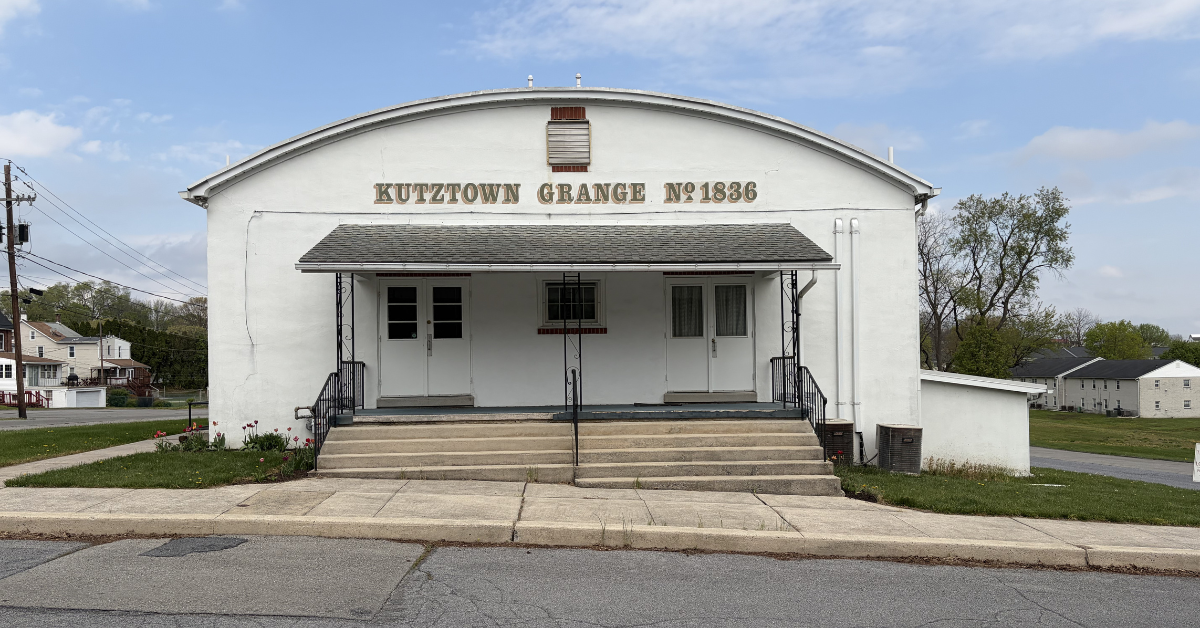
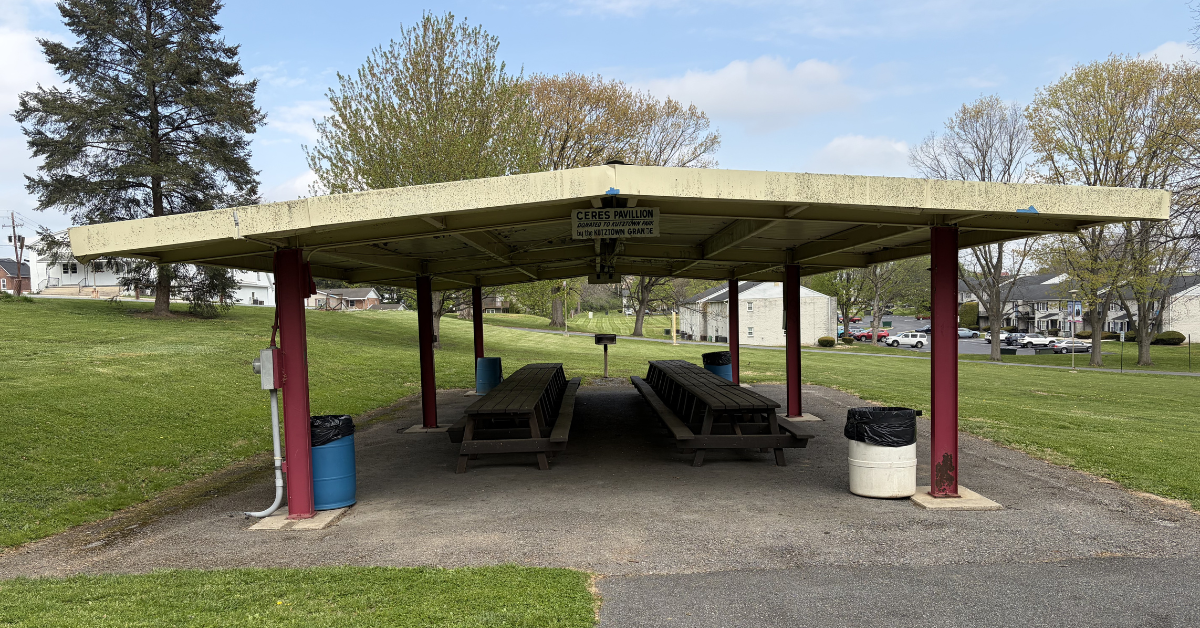
Almost every day, I walk over to Kutztown Park and sit beneath a pavilion donated by the Kutztown Grange. Just across the street stands the Kutztown Grange No. 1836 hall itself, a building I’ve passed countless times before ever really wondering what the organization was.
When I finally began researching it, I stumbled into another strange Kutztown connection. President Harry Truman was a Grange member, and during World War II, my grandfather, Leroy Brown, chauffeured Truman while stationed in Plymouth, England.
In Kutztown, these kinds of unexpected historical overlaps seem to appear everywhere — the “poetry of coincidences.”
Given the Grange’s long presence around Kutztown, I wanted to take a closer look at what this organization actually is, how it began, and why it once played such an important role in the town’s social and civic life.
What Is a Grange?
The Grange is part of the National Grange of the Order of Patrons of Husbandry, a fraternal, civic, educational, and advocacy organization founded in the 19th century to support farmers, rural families, and local communities.
The National Grange describes itself as “a family, community organization with its roots in agriculture.” It was founded in 1867 as a national organization with a local focus, giving members opportunities to develop as citizens and leaders.
The organization is built around local Community Granges, but also includes county or district, state, and national levels so members can participate in both hometown activities and broader legislative advocacy.
Over their history, local Granges hosted meetings, educational programs, lectures, meals, contests, youth activities, service projects, and community gatherings. They also gave farmers a collective voice at a time when agricultural families often felt squeezed by railroad rates, market prices, monopolies, and the growing power of industrial capitalism.
The Grange was also notable for women’s participation. The National Grange says women have been equal members since the organization’s beginning.
A Brief History of Kutztown Grange No. 1836
Kutztown’s local Grange is Kutztown Grange No. 1836, located at Kemp Street and James Alley in Kutztown.
The Kutztown Area Historical Society identifies the Kutztown Grange as beginning in 1920 under Worthy Master George J. Schaeffer, who reportedly presided for more than 25 years. That places Kutztown Grange’s founding in the early 20th century, after the national and state Grange movements were already well established.
Over the years, it functioned as one of Kutztown’s major civic organizations, connecting farming, food, youth programs, public health, education, local sports, and community service.
The Kutztown Grange sponsored a wide range of local activities, including an annual cancer fund, a Little League baseball team, a traveling library, home nursing and hygiene classes, and endorsements for the F.F.A. and F.H.A. programs at Kutztown Area High School.
Its members also participated in prize-winning food exhibits and demonstrations at the Kutztown Folk Festival and Fair, placing the Grange directly within the town’s larger agricultural and Pennsylvania Dutch cultural traditions.
At its height, Kutztown Grange reportedly had more than 300 members. Before the modern Grange Hall was built in 1949 opposite the eastern parking lot at Kutztown Park, members met on the third floor above Rothermel’s Store at 301 W. Main Street.
The current Grange Hall, built in 1949, gave the organization a permanent home near Kutztown Park. From there, the Grange continued to operate as a community gathering place, event space, and local institution.
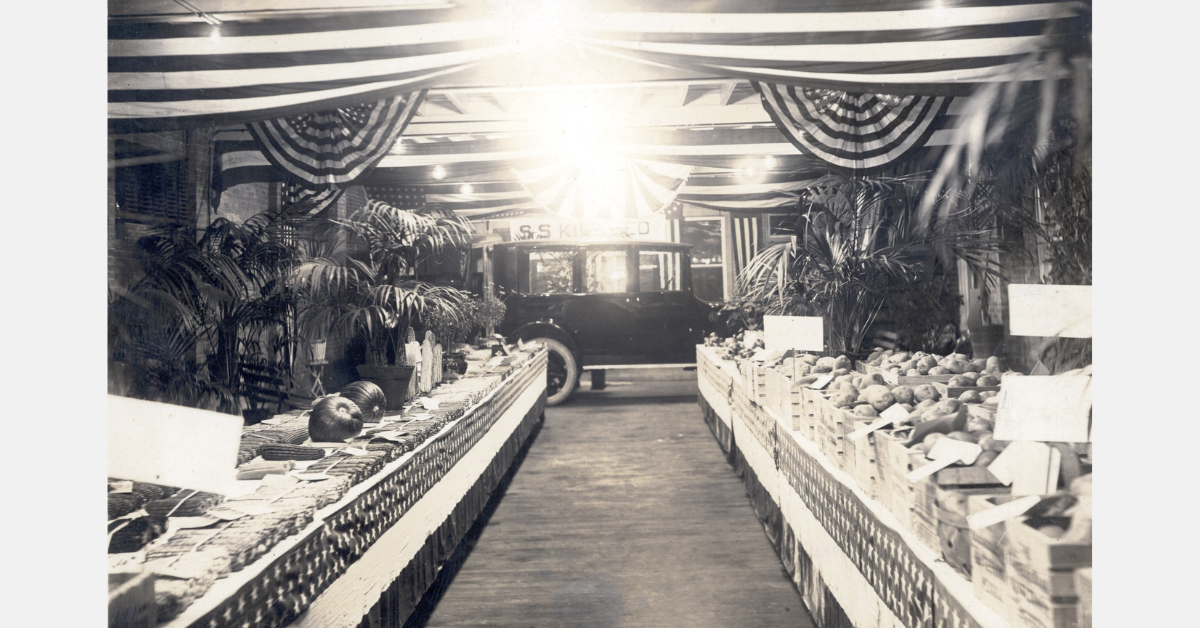
One historic Grange exhibit featured Indian corn and potatoes mounted beneath the old grandstand near the northeast turn of the Kutztown fairgrounds race track. That grandstand stood until it burned down in 1942. Ironically, the fire also destroyed all the property of the Uniformed Rank of the Kutztown Fire Company, which had used the grandstand for storage.
The Grange as Agricultural Education
One of the Grange’s major historical roles was education. Nationally, the movement was designed to help farmers and rural families share knowledge, learn from one another, and advocate for their interests.
Locally, Kutztown Grange appears to have carried that function into the Kutztown area. Newspaper references from the old Kutztown Patriot place the Grange in the world of meetings, programs, county-agricultural connections, and community education.
A 1944 Kutztown Patriot item, for example, advertised a Kutztown Grange meeting involving Henry T. Moon, an assistant county agent, suggesting that the Grange served as a local venue for agricultural information and extension-style programming.
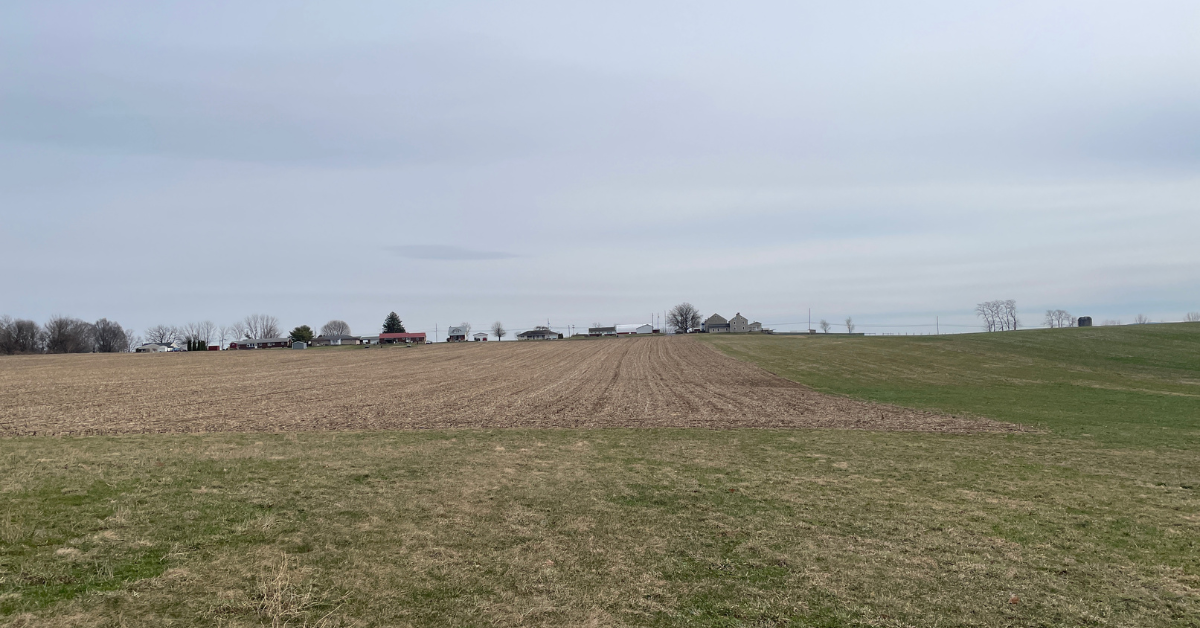
The town was surrounded by farms and rural communities, but agricultural knowledge still moved through personal networks, meetings, newspapers, fairs, and local organizations. A Grange Hall could bring that knowledge into a shared space.
The Grange as Social Life
The Grange was also a social institution. Nationally, the Grange was built around fellowship as well as advocacy. The National Grange still describes local Granges as places for service projects, educational programs, social interaction, networking, and nonpartisan legislative advocacy.
Historic newspaper references show Kutztown Grange Hall being used for events such as square dances, programs, public gatherings, and meetings. A 1957 Kutztown Patriot reference to square dances at Kutztown Grange Hall places the hall within the town’s recreational and social landscape.
This is one of the most important ways to understand the Grange Hall. It was not simply an agricultural meeting room. It was a community room. It was a place where people gathered for instruction, entertainment, meals, music, dancing, recognition, and fellowship.
Before digital life, before the decline of many fraternal organizations, and before social life became more privatized, institutions like Granges, fire halls, church basements, union halls, and civic clubs carried a huge amount of community life.
The 1920s fairground display connects the Grange to another major local tradition: the Kutztown Fair. In rural Pennsylvania, fairs were places where agricultural production, craft, food, youth activity, livestock, domestic skill, public identity, and local pride were put on display.
Today, one of the clearest signs of Kutztown Grange’s continuing public life is food. Recent public event listings connect Kutztown Grange #1836 with homemade turkey pot-pie dinners, turkey pot-pie quart sales, spaghetti dinners, potato filling, and other food-centered fundraisers.
Why the Kutztown Grange Matters Philosophically

One of the most fascinating aspects of the Kutztown Grange is that its philosophy does not fit neatly into modern political categories.
Reading the Grange’s “Business Relations” statement of their Declaration of Purpose today feels strangely disorienting because it combines ideas that contemporary Americans often assume cannot coexist.
“For our business interests we desire to bring producer and consumer into the most direct and friendly relations possible, remembering that “individual happiness depends upon general prosperity.”
We are opposed to such spirit and management of any corporation or enterprise which tends to oppress people. We long to see the antagonism between capital and labor removed by common consent, and by statesmanship worthy of an enlightened people.
We are opposed to wages and salaries that exceed productive efficiency. We recommend that farmers buy wisely and produce efficiently to make their farms profitable; to make maximum use of the innovations of science and technology; to systematize their work and to calculate intelligently on probabilities.
To all we recommend sound money management that we may avoid insolvency and bankruptcy.“
This statement:
- Advocates cooperation between producers and consumers,
- Warns against oppressive corporations,
- Critiques antagonism between capital and labor,
- Encourages technological innovation and efficiency,
- Values financial discipline, and
- Frames individual happiness as dependent upon general prosperity.
In other words, the Grange was neither traditionally socialist nor purely laissez-faire capitalist. It emerged from a world where ordinary rural people were trying to preserve community life while adapting to industrial capitalism’s rapid expansion.
“Individual Happiness Depends Upon General Prosperity”
The Grange’s worldview assumes that personal flourishing cannot be separated from the health of the broader community. A farmer cannot truly prosper if the surrounding town collapses. A business owner cannot thrive indefinitely if local institutions decay. A community cannot sustain itself if every interaction becomes purely extractive.
That philosophy closely parallels some of the themes explored in Marxist thought, particularly the critique of alienation and antagonistic class relations. The Grange statement says:
“We long to see the antagonism between capital and labor removed…”
That wording is striking because Marxism is fundamentally concerned with precisely this antagonism: the structural conflict between owners of capital and workers whose labor produces value.
The Grange does not advocate revolution or abolition of private property. But it clearly recognizes that economic systems can become oppressive when profit becomes detached from human and communal well-being.
In this sense, the Grange represents a kind of rural civic populism that overlaps with certain Marxist concerns while arriving at different conclusions. Rather than seeking class revolution, the Grange hoped antagonism could be reduced “by common consent” and enlightened statesmanship.
The Grange’s Politico-Economic Philosophy
This becomes especially interesting when compared to modern development patterns and speculative property logic. For instance, looking at East Kutztown’s vacant commercial properties, a major tension emerges between financial value and civic value.
A vacant property may possess high speculative market value because of redevelopment potential, traffic access, or investor expectations. But that same property may produce little actual civic value if it remains empty for years.
A functioning Main Street property with apartments, businesses, foot traffic, and community use may contribute far more to the town’s daily life despite being valued lower financially.
The Grange philosophy helps explain this distinction. Their statement assumes that economic activity should serve broader social prosperity rather than existing solely as an abstract financial instrument.
A property, business, or institution is valuable not only because it can accumulate speculative wealth, but because it contributes to the functioning and happiness of the community itself.
Small-Town, American Logic
This reflects an older civic logic that once shaped much of small-town America. Organizations like the Kutztown Grange did not generate value primarily through speculation or extraction. They generated value through social cohesion, public activity, mutual aid, education, food programs, youth programs, civic participation, and shared infrastructure.
The Grange Hall itself produced civic value simply by existing as a place where people could gather, organize, and cooperate. It represents a worldview in which economics was still tied to visible community outcomes.
That does not mean the Grange rejected markets, efficiency, technology, or profit. In fact, the statement explicitly encourages technological innovation, productive efficiency, and intelligent financial management.
But those goals were framed within a broader assumption: economic systems should strengthen community life rather than hollow it out.
In this way, the Kutztown Grange reveals an older American economic philosophy that sits somewhere between pure collectivism and pure individualism. It reflects a civic-agricultural worldview where prosperity was understood as relational rather than isolated.
Its philosophy assumes that prosperity is healthiest when economic activity remains connected to human relationships, local participation, and shared public life.