

I’ve noticed local political figures igniting fears over the “Marxism” and “Communism” invading our schools and academia.
In Conservative American discourse, these terms are used interchangeably. Marxism is often framed as “cultural Marxism,” a conspiracy theory suggesting the Frankfurt School neo-Marxists are subverting Christian values with multiculturalism.
Ironically, Frankfurt School Marxists like Adorno were critiquing mass culture and its impact on modern morals, the commodification of faith, and so on. He was hardly an “advocate” of multiculturalism, but rather thinking for oneself.
Even more ironic is that this “cultural Marxism” is the same tactic employed by these very critics. They tell people the school and teachers must agree with their concept of “Christian values.”
But what are Christian values? I refer to Martin Luther’s A Simple Way to Pray (c. 1535):
“It is, therefore, very important that the heart be free and ready for prayer, as Ecclesiasticus (18:23) says: “Prepare your heart for prayer, lest you tempt God.” For what is it other than tempting God when one’s mouth babbles and his heart rambles?
Such can be compared to a certain priest who prays in this way: “Make haste, O Lord, to save me! Lad, have you hitched up the team? Lord, come quickly to help me! Maid, go milk the cow! Glory be to the Father, and to the Son, and to the Holy Spirit. Hurry up, boy, get moving!” etc.
I have heard and experienced many such prayers in my day under the papacy and almost all of them trifle with God. It would be better for people to pretend praying if they cannot do any better or are unwilling to do so.
I regret that I too have prayed many canonical hours myself before I was aware that the hour was up or the psalm over with and didn’t know whether I had just begun or was in the midst of the prayer.”
Now, I’m not naive. I know words change meaning over time, but it does seem important to finally make explicit the distinction between Marxism and Communism.
Are Communism and Marxism the Same Thing?
Communism and Marxism are not the same thing.
Marxism refers to a “historical mode of analysis.”
Communism refers to a “mode of production.”
Let’s break down exactly what these terms mean.
What Is Base-Superstructure?
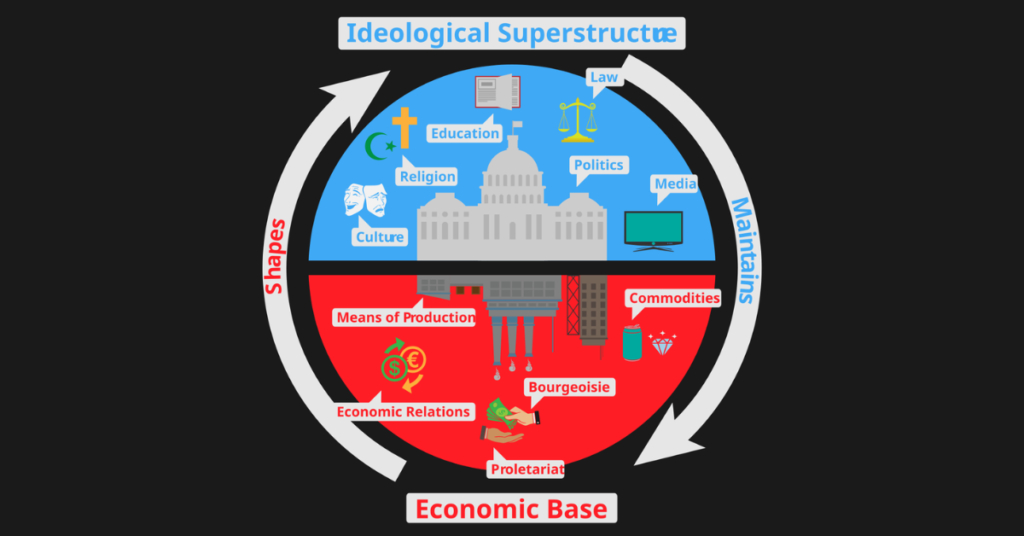
To understand the Marxist mode of analyzing society, one first needs to grasp the concept of Base-Superstructure.
Base refers to relations of production. Superstructure refers to the ideas and culture emerging from those relations.
Marx’s ideas were influenced by Hegelian dialectics, but Marx prioritized socio-economic materialism as opposed to Hegel’s Spirit.
In other words, Base-Superstructure provides the “groundwork” (no pun intended) for the process of analysis. It is not necessarily a political identity or ideology, but rather a “dialectical-materialist” analysis and interpretation of the historical phases of society’s organization.
- Base: Mode of production, comprising the socio-economic relations formed out of necessity to produce food, goods, and other essential items.
- Superstructure: The ideas, culture, and interpretations produced by those relations within a given mode of production.
What Is a Mode of Production?
A mode of production is the structure of “relations of production,” ie, the set of social relations producing the things a society needs to be a society. The mode of production is the “Base” in “Base-Superstrcuture.” Marx considers the following “phases of history” to be “modes of production.”
Hunter-Gatherer
In hunter-gatherer societies, production is organized around direct survival. Small groups gather food, hunt animals, and share resources collectively because survival depends on cooperation.
There is little permanent private property, limited specialization of labor, and relatively weak class distinctions compared to later societies. Production is primarily for immediate use rather than profit or accumulation.
The superstructure emerging from these conditions often emphasizes:
- kinship
- oral tradition
- animism or nature-based spirituality
- communal survival
- direct reciprocity
Under a Marxist analysis, the social relations of hunter-gatherer life emerge from the material necessity of surviving in small mobile groups with limited productive technology.
Feudalism
Feudalism organizes production primarily through land ownership and agricultural labor.
Under feudal relations, peasants work land controlled by nobles, lords, or aristocratic classes. In exchange for labor, taxes, or military service, peasants receive protection and access to land necessary for survival.
Social hierarchy becomes much more rigid:
- kings
- nobles
- clergy
- peasants
Economic mobility is limited because one’s social position is largely inherited. The superstructure produced by feudalism tends to emphasize:
- divine hierarchy
- inherited obligation
- monarchy
- religious authority
- tradition and stability
In Europe, Christianity became deeply intertwined with feudal organization because religious authority helped legitimize the hierarchy of the social order.
From a Marxist perspective, feudal ideas about duty, nobility, and obedience emerge partly from the material structure of feudal production itself. Furthermore, feudalism introduces the conditions of society in which capitalism can begin to take shape.
Capitalism
Capitalism organizes production through private ownership of capital and wage labor.
Rather than peasants working land directly tied to survival, workers sell their labor in exchange for wages. Goods are produced primarily for exchange and profit within markets.
Industrialization massively expands productive capacity, specialization, and technological development. Society becomes increasingly organized around:
- competition
- efficiency
- growth
- capital accumulation
Under capitalism, the primary social relation becomes the relationship between:
- capital owners (bourgeoisie)
- wage laborers (proletariat)
The superstructure emerging from capitalism often emphasizes:
- individualism
- liberal democracy
- consumer identity
- nationalism
- meritocracy
- personal freedom
Marx admired capitalism’s productive power while simultaneously arguing that its internal contradictions would eventually produce pressure for new forms of social organization.
It’s important to note that Marx came to this conclusion through the historical analysis of capitalism’s contradictions. It was not a political ideology, but a look at the structural problems within the “mode of production” of capitalism.
What Are Capitalism’s Contradictions?
Under Marxist analysis, capitalism contains internal contradictions—tensions produced by the system itself. Capitalism is highly productive and innovative, but the same forces driving growth also create instability and conflict. Some major contradictions include:
- Labor vs. Capital: Workers seek higher wages and better conditions, while firms seek lower costs and higher profits.
- Productivity vs. Employment: Technology and automation increase productivity, but can also reduce the need for labor.
- Abundance vs. Inequality: Capitalism produces enormous wealth and goods, yet many people still experience poverty and insecurity.
- Freedom vs. Constraint: Capitalism emphasizes individual freedom, but people still operate within structural limits like class, wealth, and access to opportunity.
- Growth vs. Stability: Constant expansion drives innovation, but also destabilizes communities, industries, and traditions.
For Marx, these contradictions were not accidents—they were structural features of capitalism itself.
Socialism
Socialism generally refers to a transitional mode of production in which productive resources become increasingly socially controlled rather than privately controlled.
Different socialist traditions disagree heavily on how this should occur:
- democratic reform
- worker ownership
- centralized planning
- decentralized cooperatives
- revolutionary transition
But broadly speaking, socialism attempts to reorganize production around collective social need rather than private profit accumulation alone. Under socialism:
- labor is treated more directly as a social activity
- public institutions often expand
- certain industries may become publicly owned
- redistribution mechanisms become stronger
Nearly every modern state—including capitalist ones—contains some mixture of:
- public programs
- markets
- private property
- regulation
- redistribution
For Marxists, socialism is usually understood as a historical transition emerging from the contradictions of capitalism itself.
Communism
Communism refers to a hypothetical mode of production beyond both capitalism and transitional socialism. In Marxist theory, communism describes a society where:
- class divisions disappear
- production is organized collectively
- the state as a coercive structure largely dissolves
- labor is no longer primarily organized around survival or wage dependence
Under communism, production would theoretically operate according to the principle:
“From each according to his ability, to each according to his needs.”
Rather than markets and private accumulation organizing social life, production would be directed toward shared human flourishing.
Importantly, Marx wrote relatively little detailed descriptions of what communism would concretely look like. Much of later “communist” ideology comes from political movements and states interpreting Marx differently under specific historical conditions.
This distinction matters because:
- Marxism is a method of historical and material analysis.
- Communism is one possible future mode of production proposed within that analysis.
Does Marx Have Blood On His Hands?
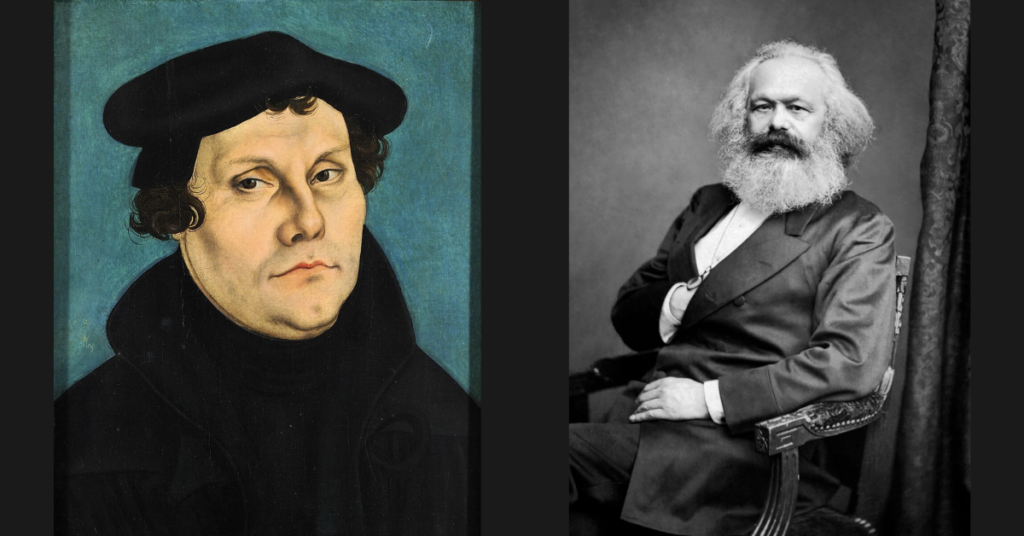
If Marx has blood on his hands, then so does Martin Luther, and Kutztown was built by Lutherans. Both proposed a radically new way of seeing of the world. At the same time, Communist ideology and the Reformation took innumerable lives.
At the end of the day, it’s not up to us to inflict moral judgement from hindsight. The pragmatist always finds kernels of truth and deception somewhere.
The question is, how do we use history, and the process of analyzing history, to make our lives better now?
Even if the word “Socialist” makes you throw up in your mouth a little, you don’t have to be a Communist to engage in Marxism.




.jpg)
.png)