
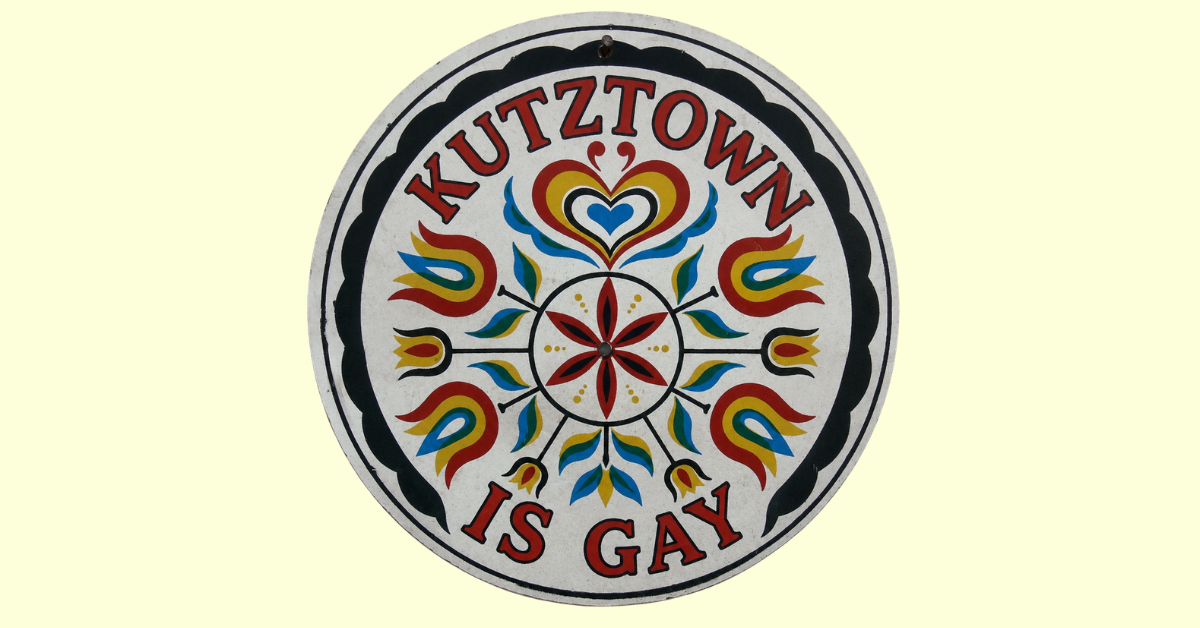
In looking for Kutztown stories to write about for Waga vum Sehne, I discovered an article written by my former Kutztown Area School District classmate, Robin Gow, published in The Gay & Lesbian Review. Gow writes:
“In all my years in Kutztown School District never once did any teacher tell me that Keith Haring was gay or even an activist. We like to think we’ve come a far way for LGBT rights. Yet in our hometown, Keith’s queerness is hushed, wriggling in the bodies of his figures. Right now, there’s even an anti-critical race theory group in town, trying to keep LGBT books out of school libraries (as well as trying to prevent schools from engaging in vital conversations about race and history).”
I can affirm with the former, and I fact-checked to confirm the latter.
Quieting Queerness
When I got a Keith Haring tattoo on my forearm senior year, I was much more attracted to the symbolism of the “Radiant Baby” than I was to any queer attachment (see Gow’s comments on the “invisibilization” of queerness while walking hallways surrounded by queer art).
To me, the tattoo seemed a great representation of childhood in Kutztown—though I do think my horny teenage mind was probably aware of the fact that it could be interpreted as a person bending over to… well, you know.
Another classmate of mine, always brash (and to be fair, already far more into drugs then I would ever be), asked if I was gay after getting the tattoo. I said no.
But being interpreted as gay was nothing really new to me. What was really anxiety was transformed through style, achievement, and aesthetics/coyness/shyness.
When I asked my mom if she thought I was gay after getting a girlfriend senior year, she said, “Well, you’ve never exactly been a Casanova.”
Unlike Jerry Seinfeld and George Constanza, I don’t really care if people think I’m gay. I don’t think Kutztown should care either.
Everybody’s Gay (Except Me)
One thinks of the Instagram videos where:
- The creator asks the subject if they are gay.
- The subject says no.
- They show the subject’s picture to another guy, and the guy always says the subject looks gay.
- Then the same thing happens to the guy who thought the other guy was gay.
The reasons they find each other gay are usually completely arbitrary, like the way someone is standing, a piece of clothing, etc. So, even if we attempt to conform to the “straight” way of appearing, we can never control the interpretation of what others consider “straight.”
Straight & White vs. Gay & Not-White
A quick lesson for the “anti-critical race theory” vanguard:
Anything not already recognized as straight, white, or socially “normal” often becomes symbolically coded as “other.” In practice, that “otherness” frequently gets interpreted as gay, foreign, deviant, strange, or “not one of us”—even when the reasons are completely arbitrary.
The moment someone deviates from the expected way of speaking, dressing, acting, or thinking, people begin projecting categories onto them.
Funny enough, Dr. Yoder, co-founder of the Kutztown Folk Festival, referred to the Amish and Mennonites as the “Plain Dutch” (those adhering to rigid, sectarian ways of life) and the more modernized Lutherans and Reformed descendants as the “Gay Dutch.”
The distinction is revealing. “Plain” here means visible conformity, uniformity, and strict adherence to “the law.” “Gay,” meanwhile, historically implied openness, colorfulness, looseness, and deviation from rigid structure.
Ironically, the hyper-conformity embraced by some modern culture-war politics begins to resemble the very kind of collectivist rigidity its supporters claim to oppose.
A Lutheran Lesson
But how do prevent anarchy without whiteness, straightness, and “the law”? To answer this, let’s turn to the Pastor of Christ Mertz Lutheran Church in Dryville:
“We are not trying to change anyone.
What we offer you and your family is a sacred space wherein change has the potential to take place. The ministry of Jesus changed the course of human history by offering us a simple solution to a complex problem.
The solution is love. Love of God, love of neighbor, sacrificial love, love of self, all these rooted in Christ, alter a person’s way of thinking, acting, and believing.
Here, at Christ Mertz Lutheran Church, we will love your family and allow you the space to be changed into the Christ-like creation God intends for all God’s people.
Standing with Love & Freedom
To be anti-love is to be anti-gay.
To be anti-gay is to be anti-Keith Haring.
To be anti-Keith Haring is to be anti-Kutztown—
Kutztown is the product of a real material history, both beautiful and painful.
It includes the WWII veterans like my grandfather, queer people who look up to Haring, and even our PA Dutch ancestors who crossed the Rhine in the early 1700s.
I stand with them all because I stand with freedom and love.