
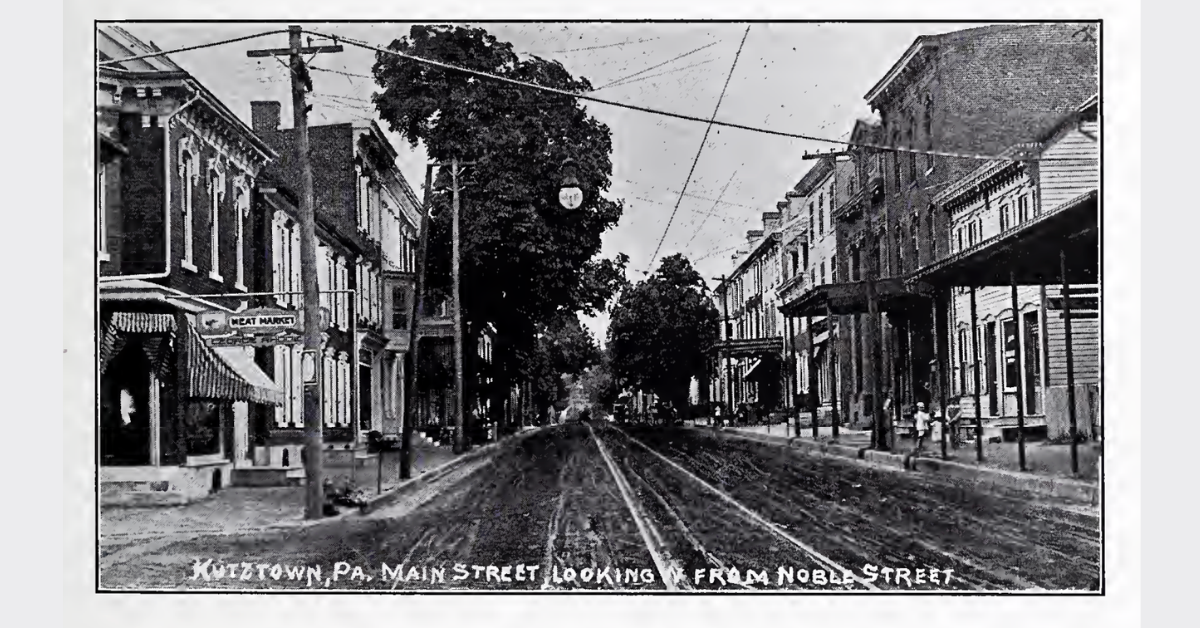
Over the course of the 19th century, Kutztown undergoes a major transformation. What had once been a small market center becomes a connected, institutionalized town tied into regional and national systems.
This transformation does not happen all at once. It unfolds through population growth, expanding transportation networks, and the development of local institutions that give Kutztown a more permanent and organized identity.
Population Growth and Expansion
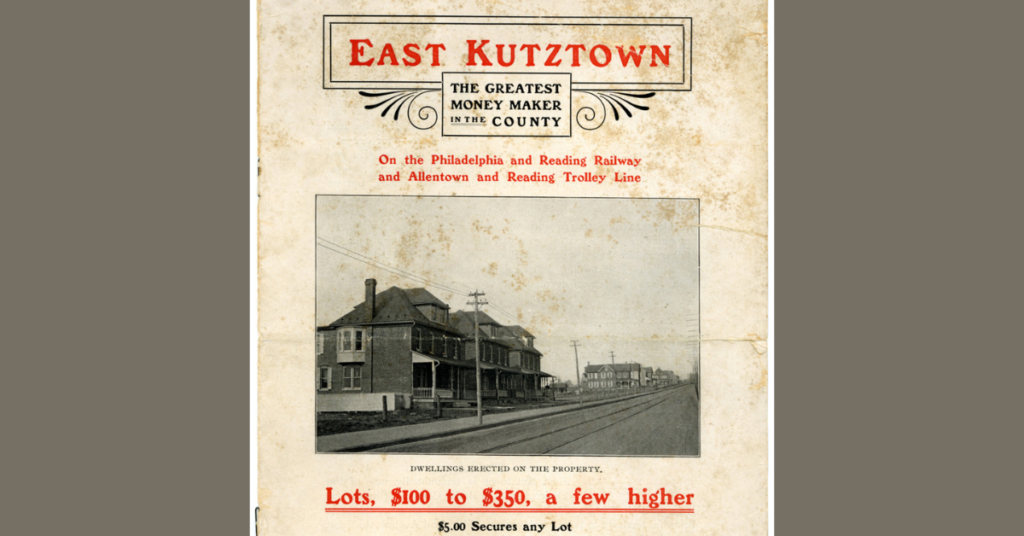
At the beginning of the 19th century, Kutztown is still relatively small. According to The ‘Lost’ 1876 Centennial Census of Kutztown, around 1800, the population is just over 200 people. But over the next several decades, the town grows rapidly:
- By the 1830s, the population reaches around 800
- By the 1860s–1870s, it approaches 900–1,000
- By 1880, it exceeds 1,100
This growth is not simply the result of natural population increase. It reflects something deeper:
- Continued migration into the region
- Movement from surrounding rural areas into the town
- Kutztown becoming a more attractive place to live and work
Horse Racing and Early Public Life
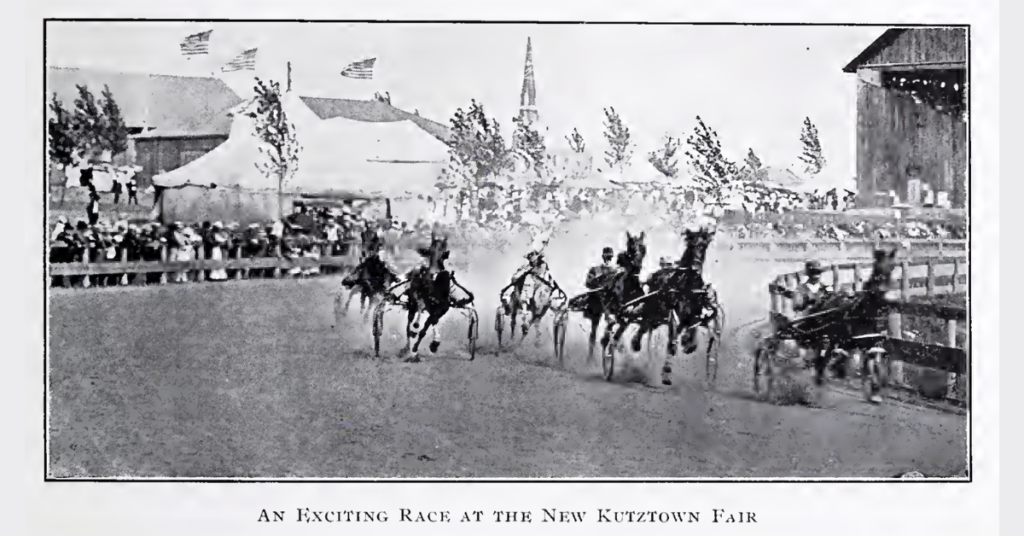
In the 1820s and early 1830s, horse races are being held on farms just outside the town, particularly on land owned by the Schaeffer family in Maxatawny Township.
Other informal tracks develop nearby, including areas east of town behind the old Levan and Kemp tavern site. Over time, these races become more structured, supported by local groups such as the Kutztown Sporting Club.
By the 1870s, racing is even taking place along the Easton Road itself, with defined start and finish points running through the edge of town.
The Kutztown Fair
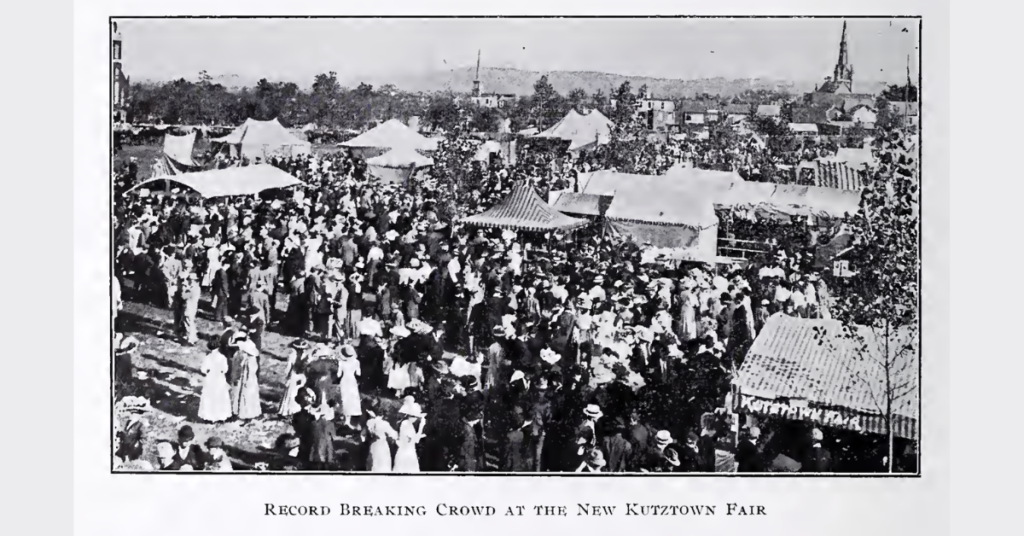
The origins of the Kutztown Fair can be traced to the early 19th century, when former soldiers gathered for what were known as “Battalion Days.”
These reunions, held by at least the 1820s, were informal and often chaotic—part commemoration, part spectacle. Veterans reenacted battles, crowds gathered, and the events blended memory with entertainment.
By 1870, the fair took on a more permanent form with the establishment of a dedicated fairground within the borough. What had once been loosely organized reunions became a structured, annual event—drawing people from across the surrounding region.
In 1905, the fair expanded again, moving to a larger site on the western edge of town. With the construction of a track, grandstand, exhibition buildings, and livestock facilities, it became a major regional attraction. Thousands attended each year, transforming the fair into one of the most prominent public events in the area.
Kutztauner Neutralist to the Kutztown Patriot
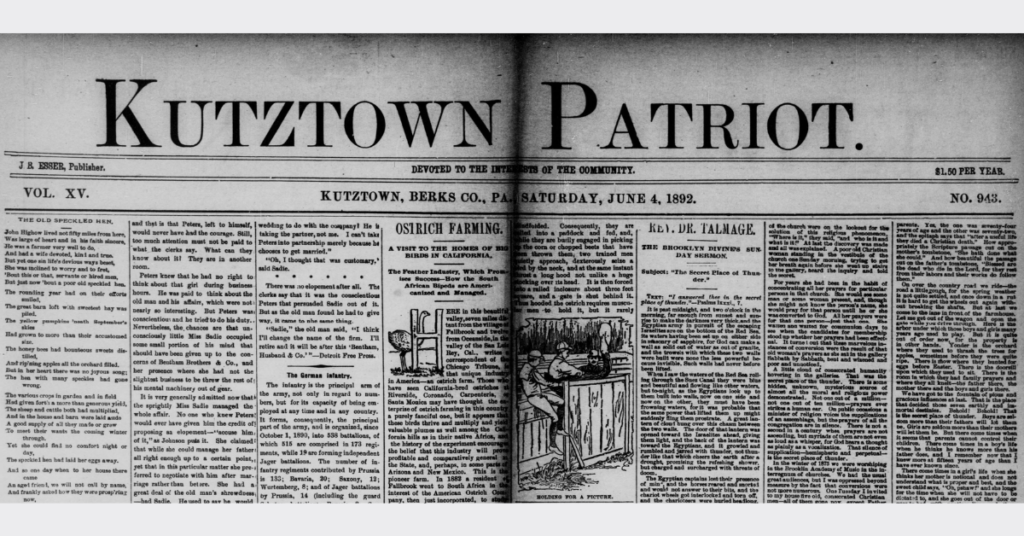
In 1834, a German-language paper known as the Kutztauner Neutralist is being published in the town. Printed by Hawrecht & Wink, it reflects the cultural world of early Kutztown:
- German is the primary language of communication
- Local businesses advertise goods and services
- The town is still closely tied to surrounding agricultural communities
The paper itself offers a snapshot of everyday life. Local figures—cabinetmakers, tanners, physicians, and merchants—advertise their work, while land is bought and sold across nearby townships. Even the name of the post office, recorded as “Coots town,” reflects a place still in the process of defining itself.
The title Neutralist is also telling. In a period shaped by political change and national development, the name suggests a community not yet fully aligned with broader national identities.
By the late 19th century, this begins to shift. English-language publications become more common, and in 1889 the Kutztown Patriot is established. Where the earlier paper reflects a local, German-speaking community, the Patriot signals a stronger identification with American national identity and greater integration into English-speaking public life.
Roads, Movement, and Regional Connection
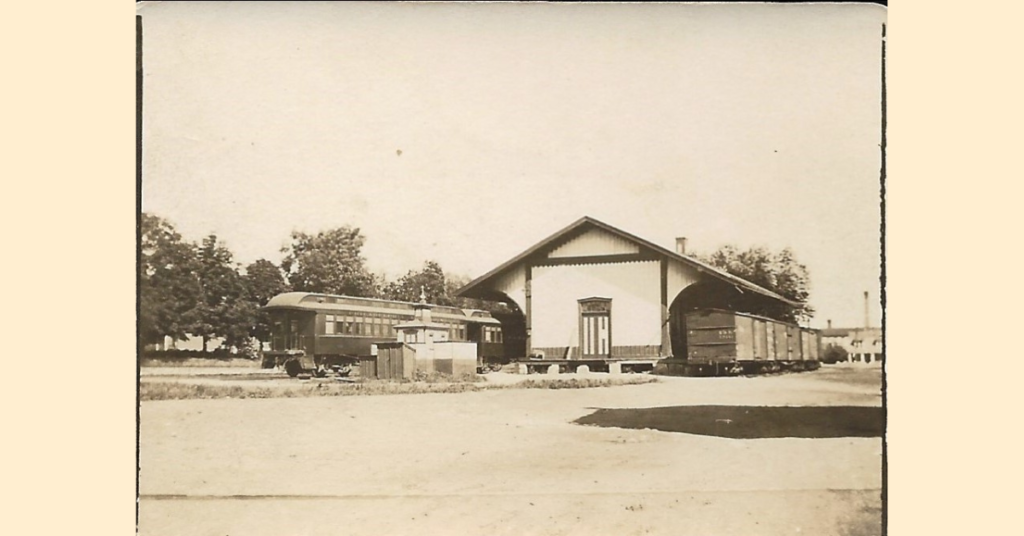
One of the most important drivers of Kutztown’s growth in the 19th century is transportation. In the early 1800s, the town is still relatively local in scope, connected mainly to nearby farms and settlements.
By the 1830s, that begins to change. In 1837, regular stagecoach service is established between Reading and Easton, passing directly through Kutztown along what is known as the Great Road (today’s Main Street / Route 222). This route becomes a key corridor, increasing the movement of people, goods, and information through the town.
As traffic increases, Kutztown begins to shift from an isolated settlement into a more connected regional hub. Trade expands, markets become more accessible, and new residents arrive from outside the immediate area.
The construction of Heffner Street—later Peach Street—and its bridge across the Saucony Creek in the 1860s and 1870s created a direct connection between the farms north of town and Kutztown’s industrial and commercial center. From there, goods could move efficiently to the Philadelphia & Reading Railroad depot. What had once required a longer, indirect route through Main Street could now bypass it entirely.
Meanwhile, before rail service reaches the town directly, Kutztown is gradually pulled into wider transportation networks. Residents often travel by carriage to nearby stations such as Lyons along the East Penn Railroad to access longer-distance travel.
Earlier attempts to bring a railroad through the area—including a partially constructed route in the 1850s—fail, leaving visible traces in the landscape and highlighting how gradual this transition to rail actually is.
That transition finally accelerates in 1870, when rail service reaches Kutztown through the Philadelphia & Reading Railroad network. This connection links the town to Reading, Bethlehem, Philadelphia, and broader industrial systems across eastern Pennsylvania.
The impact is immediate and lasting. With reliable transportation and shipment of goods, local manufacturing expands, new shops and workshops are established, and Kutztown becomes more deeply integrated into the regional economy.
American Civil War
Like many communities in Pennsylvania, Kutztown contributed soldiers to the Union cause. Men from the area—many of them Pennsylvania Dutch—enlisted in regiments and left behind farms, families, and local trades. For a town still rooted in agriculture, this had immediate effects:
- Labor shortages on farms
- Disruption of daily routines
- A closer connection between local life and national events
At the same time, the war was not only something that happened on distant battlefields. In Pennsylvania, it also moved through quieter, less visible networks. Across Berks County and the surrounding region, routes of the Underground Railroad extended northward, connecting farms, towns, and safe houses.
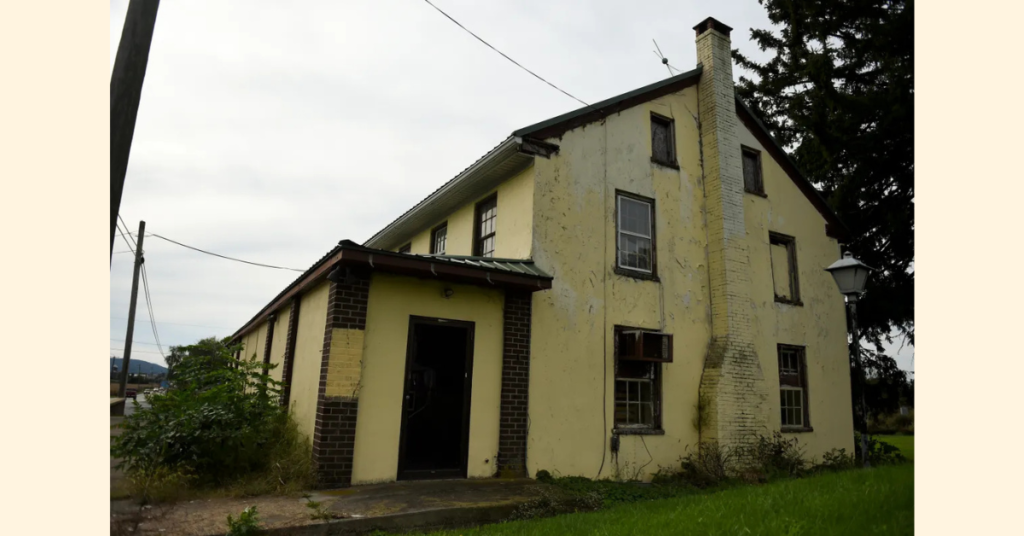
Nearby locations—including places like the Kirbyville Hotel—were part of a broader system that helped enslaved people move toward freedom. These efforts were often organized through religious and community networks, especially among Quaker and related groups, and operated in ways that blended into everyday life. Even ordinary objects could carry meaning.
Quilts, for example, may have sometimes been used as coded signals—patterns hung in plain sight that could communicate directions, warn of danger, or mark a safe house. To most people, they were just part of daily life. To others, they were information.
Economically, the war accelerated changes already underway. Demand for goods, transportation, and coordination increased across the Union, strengthening the networks that connected towns like Kutztown to larger industrial centers such as Reading and Bethlehem.
When the war ended in 1865, its effects did not disappear. Veterans returned, but the town they came back to was already beginning to change.
Economic Development and Industry
As transportation improves, Kutztown’s economy begins to diversify. Agriculture remains central, but it is no longer the only foundation of local life. New forms of economic activity emerge:
- Foundries and machine shops expand production
- Local manufacturing increases
- Trade becomes more regular and organized
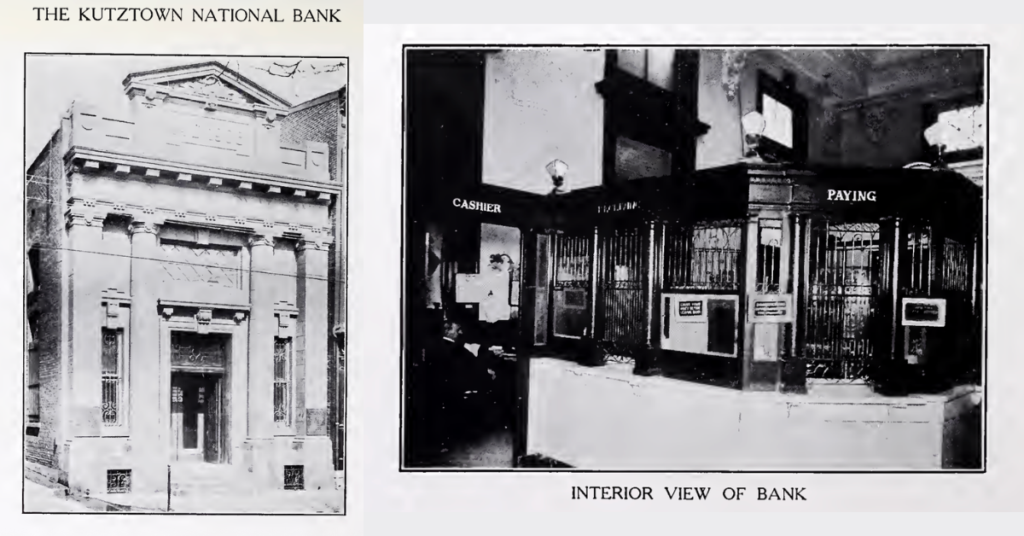
By the late 1800s, Kutztown is no longer just supplying nearby farms—it is participating in regional industrial growth. Financial institutions also appear. Between 1869 and 1871, multiple banks are established in the town, including:
- Kutztown Savings Bank
- Peabody Savings Bank
- National Bank of Kutztown
At the same time, new technologies arrive. In 1873, Kutztown establishes its first telegraph line. Communication is no longer limited to physical travel—information can now move instantly across distance.
Institutions and Civic Life
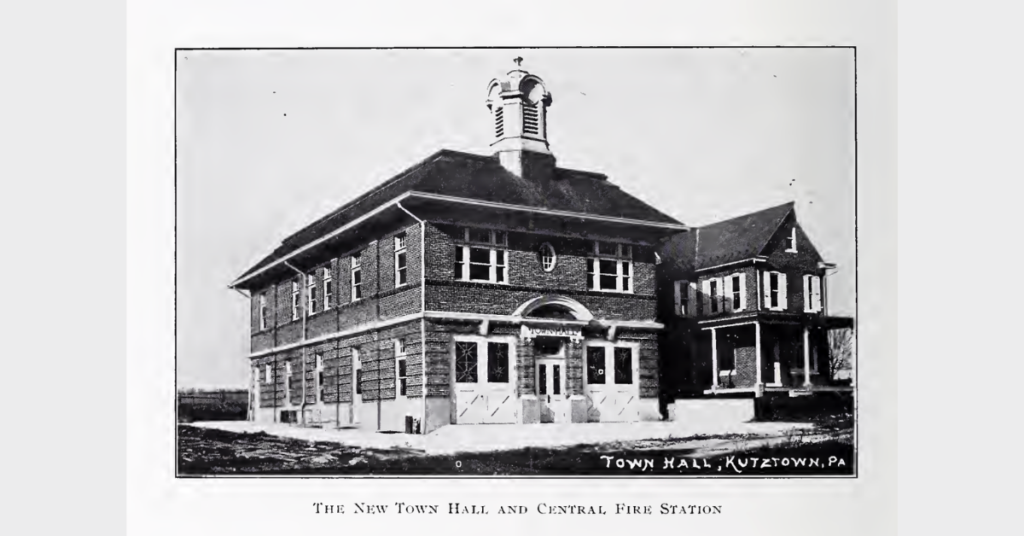
Although Kutztown was incorporated as a borough in 1815, early municipal authority was limited. The original borough framework proved ineffective—especially in improving streets—and for decades little changed in terms of infrastructure.
By the 1850s, revised laws and local ordinances finally allowed the town to begin making practical improvements, particularly to roads and sidewalks. By the mid-to-late 1800s, Kutztown includes:
- Organized cemeteries (reflecting permanence and community continuity)
- Agricultural societies and fairgrounds
- Fraternal organizations (such as Masons, Knights of Pythias, and others)
- Civic groups and local associations
The Keystone State Normal School
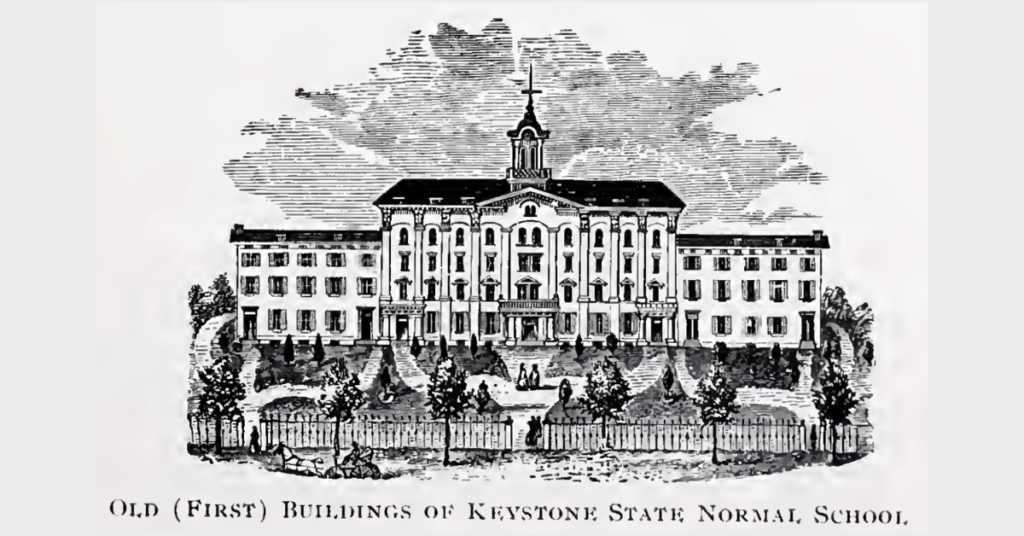
In 1866, the Maxatawny Seminary is reorganized into Keystone State Normal School. This is not just a name change—it reflects a shift in purpose.
A “normal school” is designed specifically to train teachers, meaning Kutztown is no longer just a place where people live and work—it becomes a place where people are trained to shape other communities. This has several important effects:
- Students arrive from outside the immediate area
- Teachers and administrators become part of local life
- The town gains a new intellectual and cultural dimension
At the same time, the school does not replace the town’s existing identity—it layers onto it. Kutztown remains deeply rooted in its Pennsylvania German traditions, but it is now also a place of training, instruction, and intellectual exchange.
Over time, this institution grows and evolves, eventually becoming Kutztown University. But even in its early form, the Normal School signals something new: Kutztown is no longer just part of a regional system—it is beginning to influence it.
The Discovery of Crystal Cave
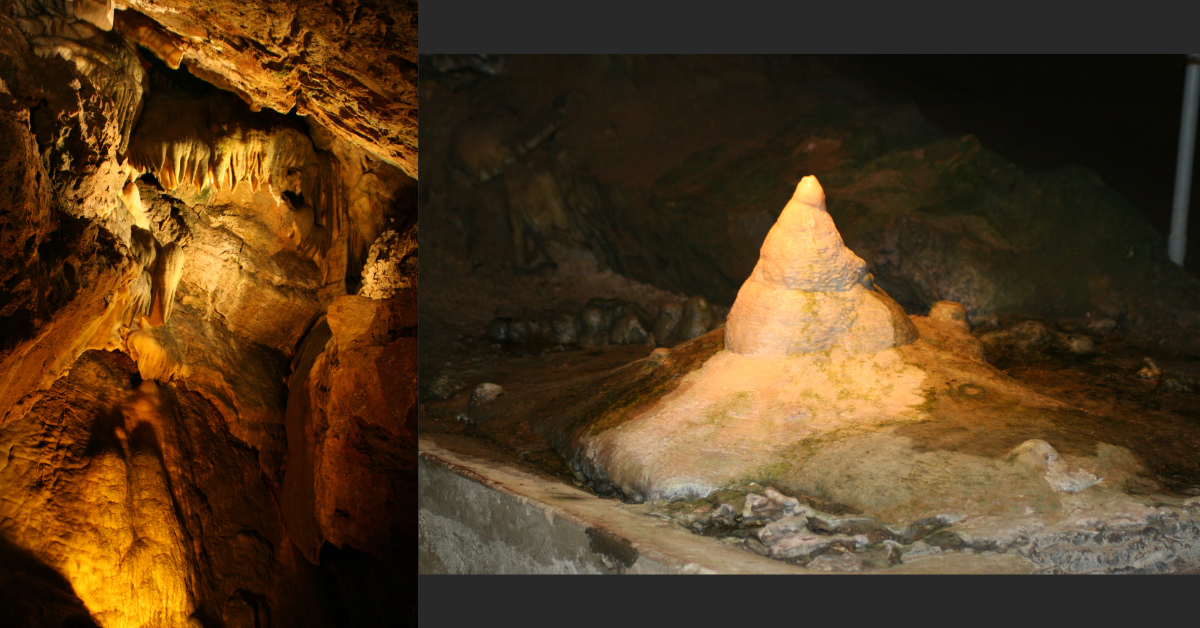


Crystal Cave, found on November 12, 1871, quickly became one of the area’s most notable attractions. Over time, it became one of the earliest commercial caves in Pennsylvania, bringing visitors into the region and adding a new kind of destination to the local economy.
At the same time, Crystal Cave was not unique. The geology of the area—particularly the limestone formations along the Saucony Creek—made the region well suited for cave development. Dozens of smaller caves exist nearby, though most remain closed, undeveloped, or inaccessible.
Baseball and the Saucony Nine
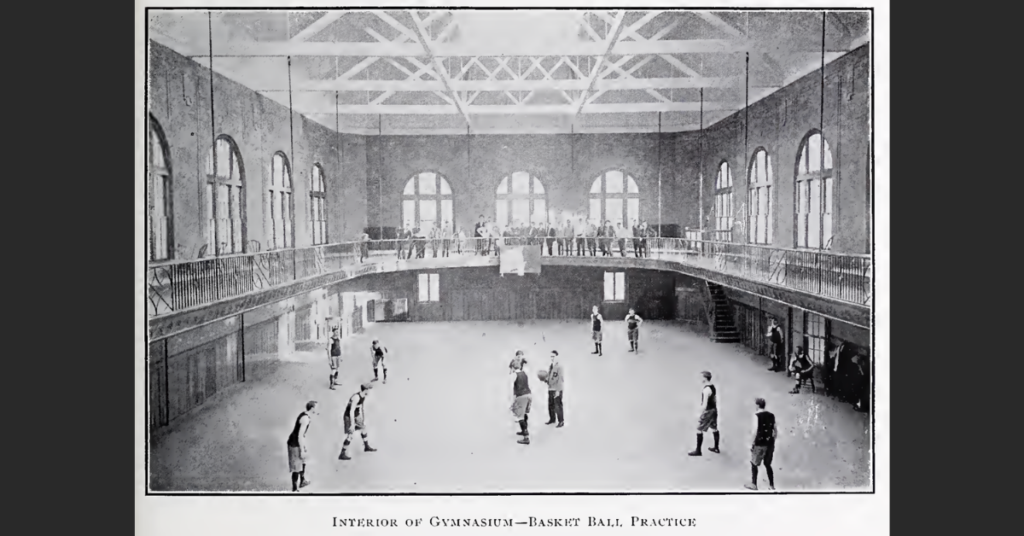
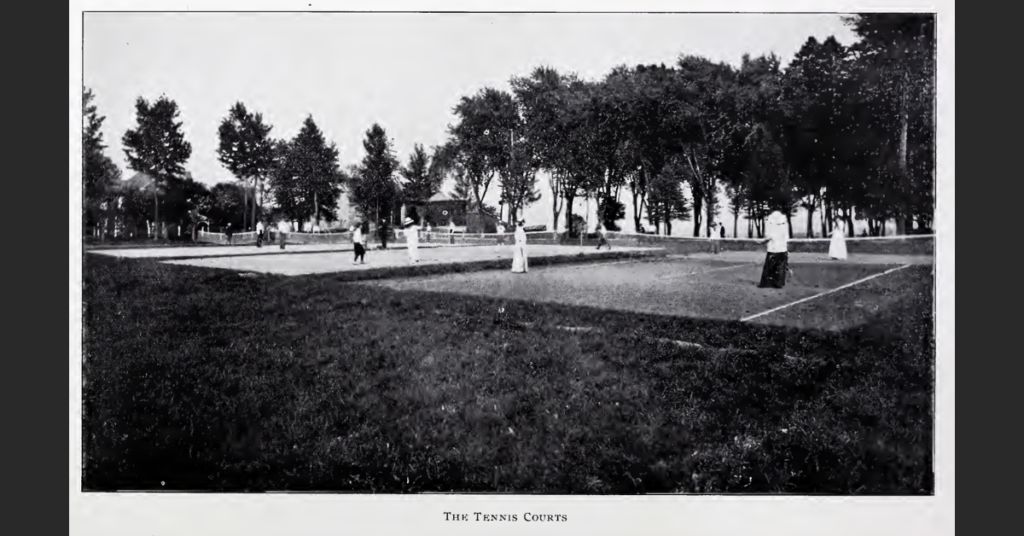
At a time when baseball is still in its early stages, Kutztown forms its own team, known as the Saucony Nine, with a playing field near the Saucony Creek. The presence of the Keystone State Normal School helps drive this development, bringing students and new forms of recreation into the town.
Games draw crowds. Rivalries form, particularly between the town team and the Normal School. Matches are lively, high-scoring, and loosely structured by modern standards.
Religious Division and the First “Schism”
As Kutztown grows through the 1800s, its identity remains deeply rooted in its Pennsylvania German religious traditions—especially Lutheran and German Reformed communities. Churches are not just places of worship; they are central to social life, authority, and community structure.
But growth brings tension. By the 1870s, Kutztown faces one of its first major internal conflicts—a religious division described at the time as a “schism.”
At the center of this conflict is St. John’s Church, which had long served as a shared religious institution in the town. For decades, it functioned as a “union church,” meaning that multiple Protestant groups—primarily Lutheran and Reformed—used the same building and shared space.
As the town grows, this arrangement begins to break down. Differences in belief, organization, and identity—once manageable in a smaller community—become harder to contain. By 1876, the tension reaches a turning point:
- A vote is held within the congregation to build a new sanctuary
- The decision passes, but not unanimously (279–77)
- The process leads to the creation of a separate, fully Lutheran congregation
This marks a shift from shared religious space to denominational separation. The consequences are immediate:
- Rev. George F. Spieker, the Lutheran pastor at St. John’s, resigns
- A new congregation—Trinity Evangelical Lutheran Church—is formally organized in 1876
- Leadership structures reorganize, with new pastors and institutional lines drawn
For a town that had long relied on shared structures, this is a significant moment. It represents not collapse—but differentiation. Even as Kutztown prepares to celebrate its growth and unity during the Centennial era, it has already experienced internal division.
The timing is striking. Just weeks before major celebrations of unity and prosperity, the town undergoes its first major religious split
And yet, the community adapts. Despite the tension, Kutztown continues to grow—politically, economically, and socially. Local leadership organizes civic life, institutions expand, and the town moves forward.
A Town Fully Formed
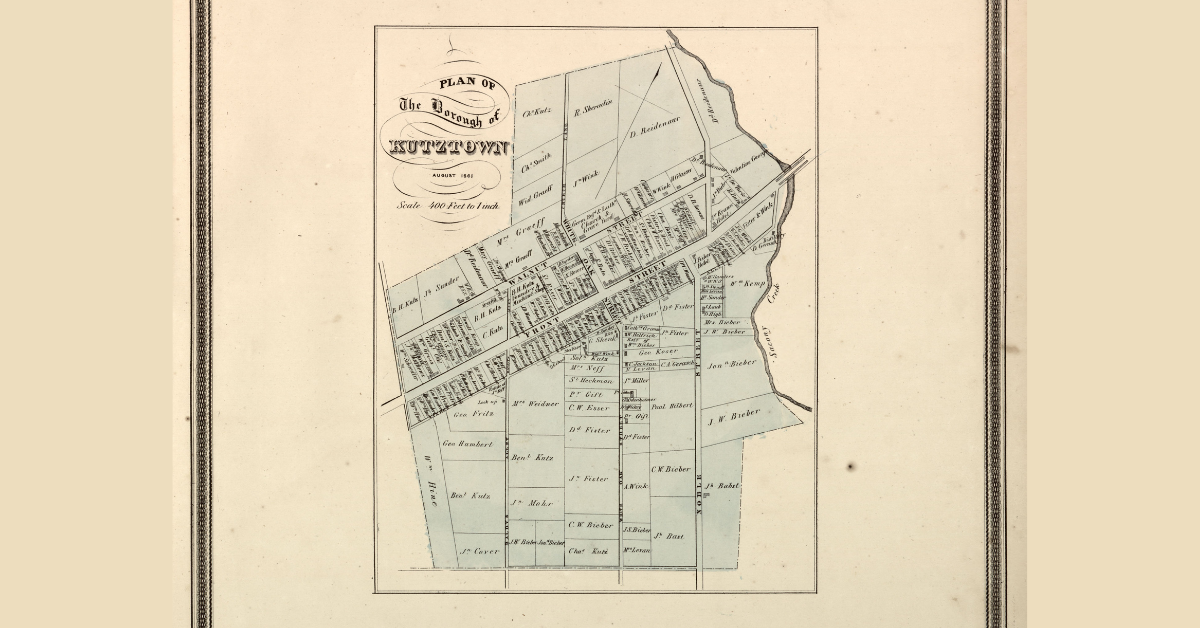

By the late 1800s, Kutztown has undergone a complete transformation. It is no longer frontier zone, loose network of farms, or newly founded market town. It is now:
- A connected transportation hub
- A growing population center
- A town with financial, educational, and civic institutions
- A community integrated into regional and national systems